 |
 |
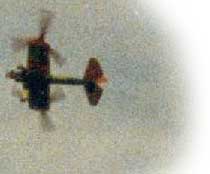
A simple and easy to fly autogyro can be made from a lightly built trainer, in this case a .15 to .25 size model, a stub wing, and simple wooden rotors.I made a few of these and they were fun to fly. |
 |
 |
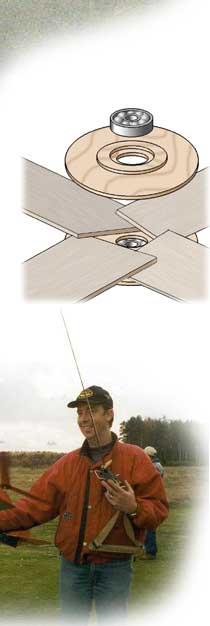
same as with a conventional trainer without ailerons as it works the same way. The rotor blades are from 3 mm hard balsa sheet 4,5 x 30 cm. Eight rotorblades are made, as are four 6 cm diameter discs from 1,5 mm plywood. Small ball bearings, two in each rotor will be needed. Axels can be made from M4 or M5 thread rod depending on the size of the bearings. Rings from 1,5 mm plywood glued to the hubs keep the bearings in place. |
 |
|
 |
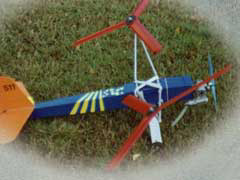 |
The axles are bound and epoxied to the stub wing to give the rotors about 5 degrees angle of incidence. The rotorblades are given negative incidence ( pitch ) by gluing them over each other. This gives a little too much incidence, but it works. Make one right (for clockwise rotation ) and one left rotor ( for counterclockwise rotation ). |
|
 |
Observe that this is not considered a true autogyro as the stub wing gives part of the lift, and these paddle shaped rotorblades aren´t very effective. This is a simple and fun way to make an autogyro, and who cares if it´s considered cheating!
|
 |
|
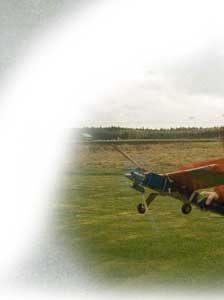
| The blue autogyro here flew with outriggers made from thin aluminum tubing. It flew, but it's a .10 or .15 size model fuselage, and it required a .40 to fly with rotors. And boy, was it fun!!! |
Björn's.©2001.